TL;DR
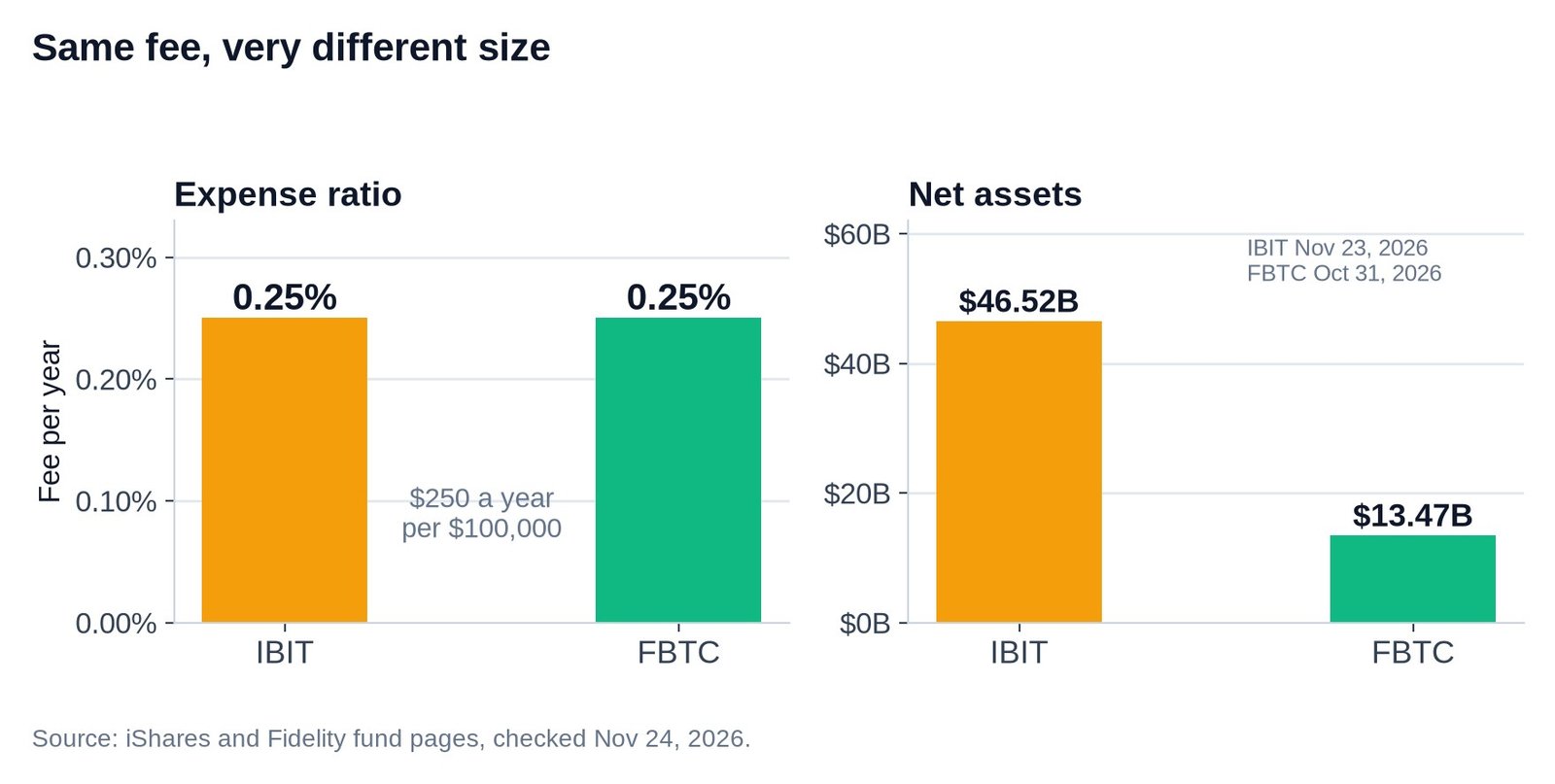
1. Both charge 0.25% a year. On $100,000 that is $250 — identical, so the fee is not the deciding factor between IBIT and FBTC.
2. IBIT is far bigger ($46.52B versus $13.47B) and trades about eight times as many dollars a day, with a 0.02% median spread against FBTC’s 0.04%.
3. The real choice is the custodian: Coinbase Custody for IBIT versus Fidelity Digital Assets for FBTC. Bitcoin has no staking yield, so neither fund can pay you one.

IBIT and FBTC launched within days of each other in January 2024, both hold bitcoin directly, and both charge 25 basis points. On paper they look like the same product from two brand names.
They are not quite. One is roughly three and a half times larger, trades far more actively, and stores its bitcoin with the largest US crypto custodian. The other keeps its coins inside Fidelity’s own trust bank.
Here is what the two fund companies’ own pages say, checked on Nov 24, 2026, and what it means for a $100,000 position.
The numbers
| IBIT iShares Bitcoin Trust ETF |
FBTC Fidelity Wise Origin Bitcoin Fund |
|
|---|---|---|
| Sponsor fee | 0.25% | 0.25% gross and net |
| Cost on $100,000 | $250 a year | $250 a year |
| Net assets | $46.52B (11/23/2026) | $13.47B (10/31/2026) |
| Average daily volume | 50.1M shares (30-day) | 4M shares (90-day) |
| 30-day median spread | 0.02% | 0.04% |
| Bitcoin custodian | Coinbase Custody Trust Company, LLC; Anchorage Digital Bank N.A. as an additional custodian | Fidelity Digital Assets, N.A.; BitGo Bank & Trust, N.A. as an additional custodian |
| Cash custodian | The Bank of New York Mellon | State Street Bank and Trust Company |
| Structure | Delaware statutory trust | Grantor trust |
| Exchange | Nasdaq | Cboe BZX |
| Inception | 01/05/2024 | 01/10/2024 |
Sources: ishares.com IBIT fund page, iShares prospectus and Fidelity’s FBTC quote page and fact sheet. All figures checked Nov 24, 2026; as-of dates are shown because the two pages update on different schedules.
The fee story is over
When spot bitcoin ETFs launched, fees were the whole conversation. Issuers waived them, cut them and fought over basis points.
That phase is settled. Both of these funds now charge the same 0.25%, and both charge it the same way: accrued daily in bitcoin, paid monthly. On $100,000 you pay about $250 a year either way — roughly $21 a month.
A 25 bp fee is not free, and it is not nothing. Because the fee is paid by selling a slice of the trust’s bitcoin, the amount of bitcoin behind each share slowly falls. Over five years, at no change in price, 0.25% a year adds up to roughly 1.25% of your position.
What $100,000 costs in each fund
Because the fee is a percentage, the dollar difference between the two funds is zero. The costs that do differ are trading costs, and they are one-off.
| On a $100,000 position | IBIT | FBTC |
|---|---|---|
| Sponsor fee, per year | $250 | $250 |
| Sponsor fee over 5 years, no price change | about $1,250 | about $1,250 |
| One round trip across the spread | about $20 (0.02%) | about $40 (0.04%) |
| Average daily dollar volume | about $1.65B | about $0.21B |
| Distribution or staking income | None | None |
Fee and spread figures from the fund pages, checked Nov 24, 2026; dollar volume computed from published average daily volume and closing prices. The five-year figure is simple multiplication and ignores bitcoin price changes, which dominate the outcome.
Liquidity: the difference you feel on an order
IBIT is the larger fund and the more heavily traded one. Its own page reports a 30-day average daily volume of 50.1 million shares and a 30-day median bid/ask spread of 0.02%. FBTC reports a 90-day average of 4 million shares and a 0.04% median spread.
Multiply those share counts by each fund’s price and you get the dollar figures that matter: roughly $1.65 billion a day for IBIT against $0.21 billion for FBTC.
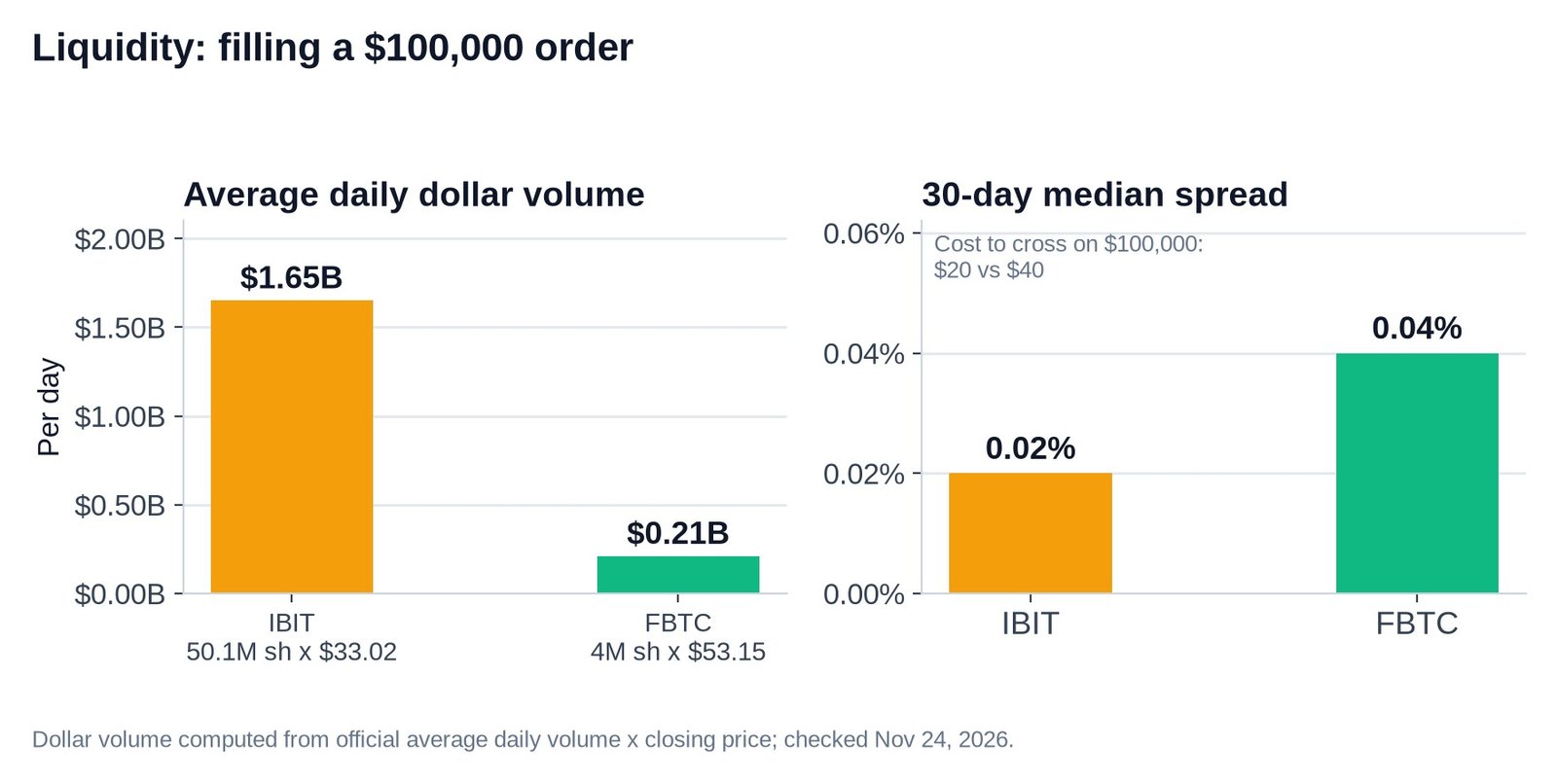
For a $100,000 retail order, both are deep enough that you will not move the price. The spread still costs you something: at 0.02% you cross about $20, at 0.04% about $40.
Premium and discount is the other liquidity signal. FBTC’s page reported a 1-month rolling average premium of +0.02% and a single-day discount of −0.43% on Nov 23; small gaps between price and bitcoin value happen on volatile days, and the bigger, more arbitraged fund tends to close them faster.
Custody: who actually holds the coins
This is the part worth reading the prospectus for, because you are trusting a third party with a bearer asset.
IBIT keeps its bitcoin with Coinbase Custody Trust Company, LLC, with Anchorage Digital Bank N.A. named as an available additional custodian. Cash sits at BNY Mellon. The trust is a Delaware statutory trust sponsored by an iShares entity, and the prospectus describes private keys held in cold storage, segregated from Coinbase’s own assets.
FBTC keeps its bitcoin with Fidelity Digital Assets, N.A., a national trust bank and an affiliate of the fund’s sponsor, with BitGo Bank & Trust as an additional custodian. Cash sits at State Street, and the fund is structured as a grantor trust.

Two things neither fund protects you from. Neither is registered as an investment company under the 1940 Act, so you do not get mutual-fund style protections. And if the custodian loses the coins, your claim is against the trust’s estate — the shares are still a claim on bitcoin, not bitcoin in your own wallet.
ETF versus owning bitcoin yourself
Direct ownership removes the 0.25% fee and gives you the keys, the 24/7 market and the ability to send bitcoin anywhere. In exchange you take on wallet security, seed-phrase backup, exchange risk when you buy, and the fact that most brokers cannot hold it inside a retirement account.
The ETF gives you a ticker, a custodian, ordinary brokerage settlement, and the ability to hold it inside a tax-advantaged account — Fidelity, for example, lists its bitcoin fund as available in most brokerage, trust and IRA accounts.
On staking: bitcoin has no staking yield. It runs on proof of work, so there is nothing to stake and neither IBIT nor FBTC can pay you a staking reward. If staking income is what you want, that is an ether or solana product question — Fidelity’s own crypto fund page, for instance, describes its FETH and FSOL funds as offering staking reward distributions. A bitcoin ETF will never do that.
Which one to pick
IBIT if liquidity, tight spreads and the deepest order book matter — for large orders, frequent trading, or options strategies around the position.
FBTC if you already bank with Fidelity, want custody inside a Fidelity trust bank, or prefer a grantor trust structure. Same fee, smaller fund, slightly wider spread.
At equal fees there is no cost reason to prefer one. The honest tiebreaker is where your account already is and which custodian you trust with the coins.
Frequently asked questions
Is IBIT or FBTC cheaper?
Neither. Both charge 0.25% of net asset value a year, accrued daily and paid in bitcoin, which is $250 on a $100,000 position.
Who custodies the bitcoin?
Coinbase Custody Trust Company for IBIT, with Anchorage Digital Bank as an additional custodian. Fidelity Digital Assets, N.A. for FBTC, with BitGo Bank & Trust as an additional custodian.
Do these ETFs pay dividends or staking rewards?
No. Both have no distribution schedule, and bitcoin has no staking mechanism. Any yield you see quoted for a bitcoin product is not staking income.
Can I convert shares into actual bitcoin?
Not as an ordinary investor. Shares are bought and sold on the exchange like any ETF; only authorized participants create and redeem in large blocks.
Sources and how we checked
Figures come from the fund companies’ own pages and filings, read on Nov 24, 2026.
- iShares Bitcoin Trust ETF (IBIT) — sponsor fee, net assets, NAV, volume, spread, shares outstanding.
- IBIT prospectus — trust structure, Coinbase Custody, Anchorage as additional custodian, BNY Mellon cash custody, cold storage.
- Fidelity FBTC quote page — expense ratio, net assets, average volume, spread, premium/discount, shares outstanding, bitcoin per share.
- FBTC prospectus (April 29, 2026) — 0.25% sponsor fee, Fidelity Digital Assets as custodian, BitGo, State Street.
- FBTC fact sheet (September 30, 2026) — portfolio assets and expense ratios.
- Fidelity crypto funds — expense ratio confirmation and custody description.
Disclosure. ETF Sheet is an independent information site, not affiliated with BlackRock, iShares or Fidelity. This is education, not investment advice. Bitcoin is highly volatile: on the pages we checked, IBIT’s one-year total return was negative, and the fund can lose value quickly. Read the prospectus before investing.
Free · weekly
Get the ETF sheet
One email a week: ETF and dividend comparisons with the numbers laid out — expense ratios, yields, holdings overlap, and the sheets we publish.
Free, no spam. Unsubscribe in one click.