TL;DR
1. The old $25,000 Schwab International minimum is gone: Schwab’s current pricing guide lists the Schwab One International account at a $0 minimum, and Interactive Brokers lists $0 for individual accounts.
2. For US-listed ETFs, Schwab charges $0 online and IBKR Pro charges $0.005 per share with a $1 minimum per order — about $14.55 on a $100,000 order.
3. The bigger gap is currency: Schwab marks up conversions by up to 3% (up to $3,000 on $100,000), while IBKR charges 0.20 basis points with a $2.00 minimum.

If you live outside the US and want to buy American ETFs, these are the two names that come up first. Both open accounts for non-residents, both require a W-8BEN, and both have removed the account minimums that used to keep small investors out.
What still separates them is how they charge you: Schwab sells trading for free and makes money on conversions and service, while IBKR charges a small per-share commission and passes currency through at close to interbank rates.
Every number below comes from the two firms’ own fee schedules and account pages, read on Nov 24, 2026.
Side by side
| Interactive Brokers (IBKR Pro) | Schwab One International | |
|---|---|---|
| Minimum to open | $0.00 | $0 (April 2026 pricing guide) |
| Inactivity fee | $0.00 | $0 account fee |
| US-listed stock/ETF, online | $0.005/share, $1.00 min, 1% of trade value max (fixed) | $0 |
| Same trade, broker-assisted | $30 per order, closing orders only | $25 per trade ($5 by automated phone) |
| Currency conversion | 0.20 bp of trade value, $2.00 minimum; automatic conversion adds/subtracts 0.03% | Markup of up to 300 bp (3%) |
| Withdrawals | Two free per calendar month, then $10 bank wire / $1 ACH (USD) | Outgoing wire $25, or $15 if submitted online; incoming wire free |
| Non-US ETFs (UCITS) | Access to many non-US exchanges | Broker-assisted only, $50 transaction fee; not available online |
| Tax form | W-8BEN required; valid about 3 years | Substitute W-8BEN required at opening; renewed every 3 years |
| Who can open | Residents of most countries, excluding those on US sanctions lists | Residents of qualifying countries only; not all products available everywhere |
Sources: Interactive Brokers Required Minimums, Commissions, Spot Currencies and Other Fees pages; Charles Schwab Pricing Guide for Individual Investors (April 2026) and international.schwab.com. All checked Nov 24, 2026.
About that $25,000. If you have read that Schwab International requires $25,000 to open, the figure is out of date. The pricing guide Schwab publishes today lists the Schwab One International account’s minimum deposit as $0. Older blog posts and comparison tables still repeat the old number.
Opening the account as a non-resident
Both brokers treat you as a non-US person and ask for the same core documents: passport, proof of address, and a tax form. Neither requires you to visit the United States.
Schwab’s international application asks for a Substitute Form W-8BEN, a full-page copy of your passport including the signature page, and a recent utility bill showing your name, address and date. IBKR collects the same identity and address evidence inside its online application and requires a W-8 form before the account can trade.
The practical difference is availability. IBKR states that it accepts applications from citizens or residents of most countries, except those subject to US sanctions. Schwab routes you through a country selector first and only some countries can complete an application.
Trading costs on a $100,000 order
Assume you already hold US dollars and buy $100,000 of a US ETF in one online order. At SCHD’s Nov 23 NAV of $34.36 that is 2,910 shares.
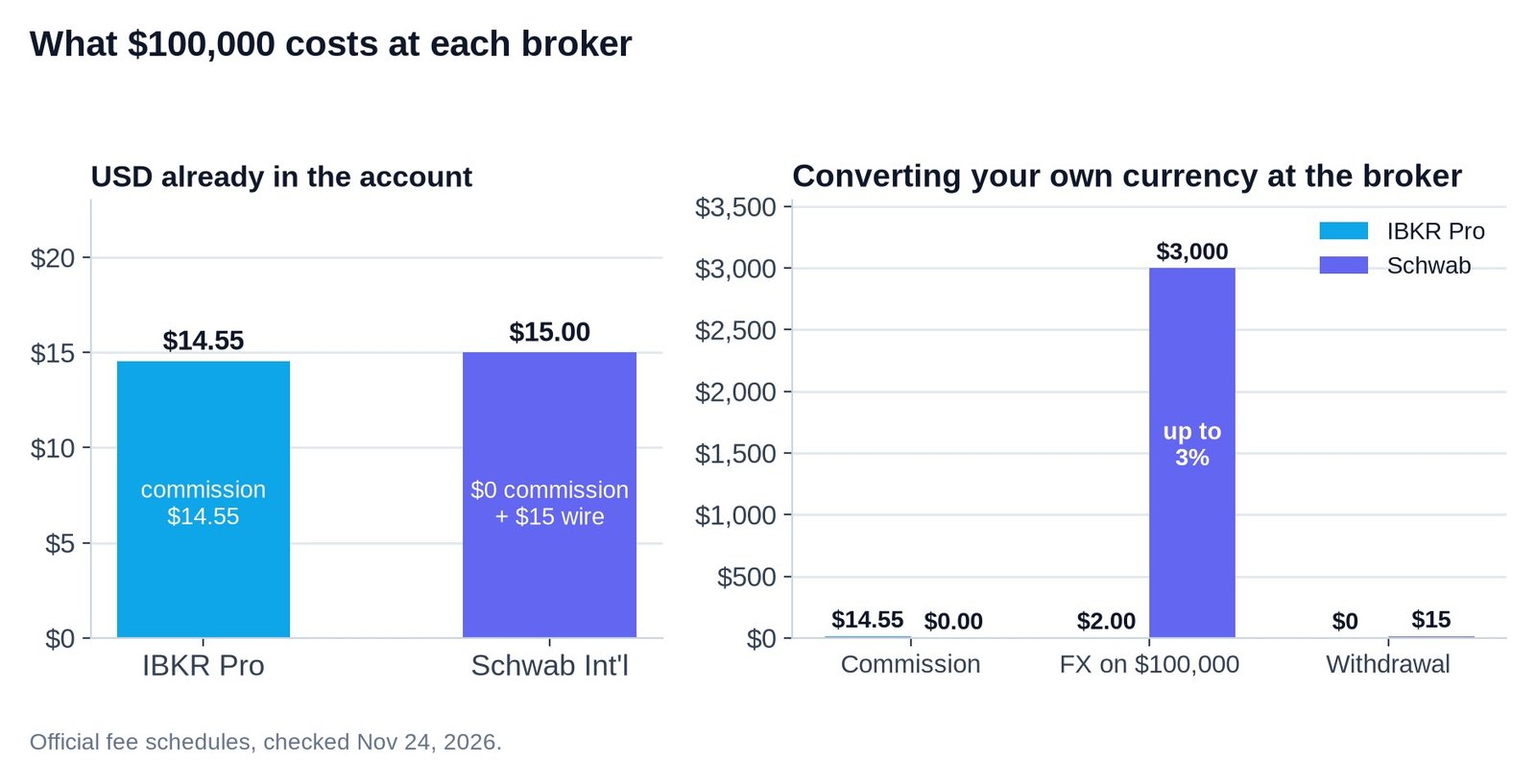
Schwab charges $0 for that online trade. IBKR Pro’s fixed plan charges $0.005 a share, so $14.55 — the $1 minimum does not bind at this size, and the 1% cap does not either.
One caveat on IBKR Lite. IBKR’s $0 commission plan is IBKR Lite, which the firm describes as available to eligible US and Singapore residents. If you live elsewhere, plan on IBKR Pro pricing — per-share commissions with a $1.00 minimum per order.
The full cost, line by line
Add the pieces together and the two fee models separate cleanly. This table uses one $100,000 order, one conversion and one withdrawal — the pattern of a typical long-term investor, not a day trader.
| Cost item | IBKR Pro | Schwab One International |
|---|---|---|
| One $100,000 US ETF order, online | $14.55 (2,910 sh x $0.005) | $0 |
| Converting $100,000 into USD at the broker | $2.00 (0.20 bp, $2 min) | up to $3,000 (3% markup) |
| Withdrawing the money later | $0 (first two a month) | $25 wire / $15 online |
| A year of 12 x $1,000 monthly buys | $12.00 ($1 min each) | $0 |
| Year one, if you fund with local currency | about $16.55 | up to about $3,025 |
Our calculation from the published fee schedules, checked Nov 24, 2026. Bank charges on your side of the wire are not included, and Schwab’s 3% is a maximum markup, not a fixed rate.
The real difference: currency
Most investors outside the US do not start with dollars. They wire local currency, or convert inside the account, and that is where the two brokers diverge sharply.
Schwab’s pricing guide states a foreign currency conversion markup of up to 300 basis points — 3% of principal. On $100,000 that is up to $3,000. IBKR charges 0.20 basis points on spot currency trades, with a $2.00 minimum per order, so $100,000 converts for about $2.
If your money arrives as dollars from a US-dollar account, the Schwab markup never applies and this advantage disappears. If you are funding from won, euros or yen, it is the largest single line in the comparison.
How much this matters depends on how often you convert. A one-off $100,000 conversion is a $3,000 difference at the top of Schwab’s range. Monthly conversions of $1,000 compound the same percentage difference twelve times a year.
And the opposite case: small, frequent orders
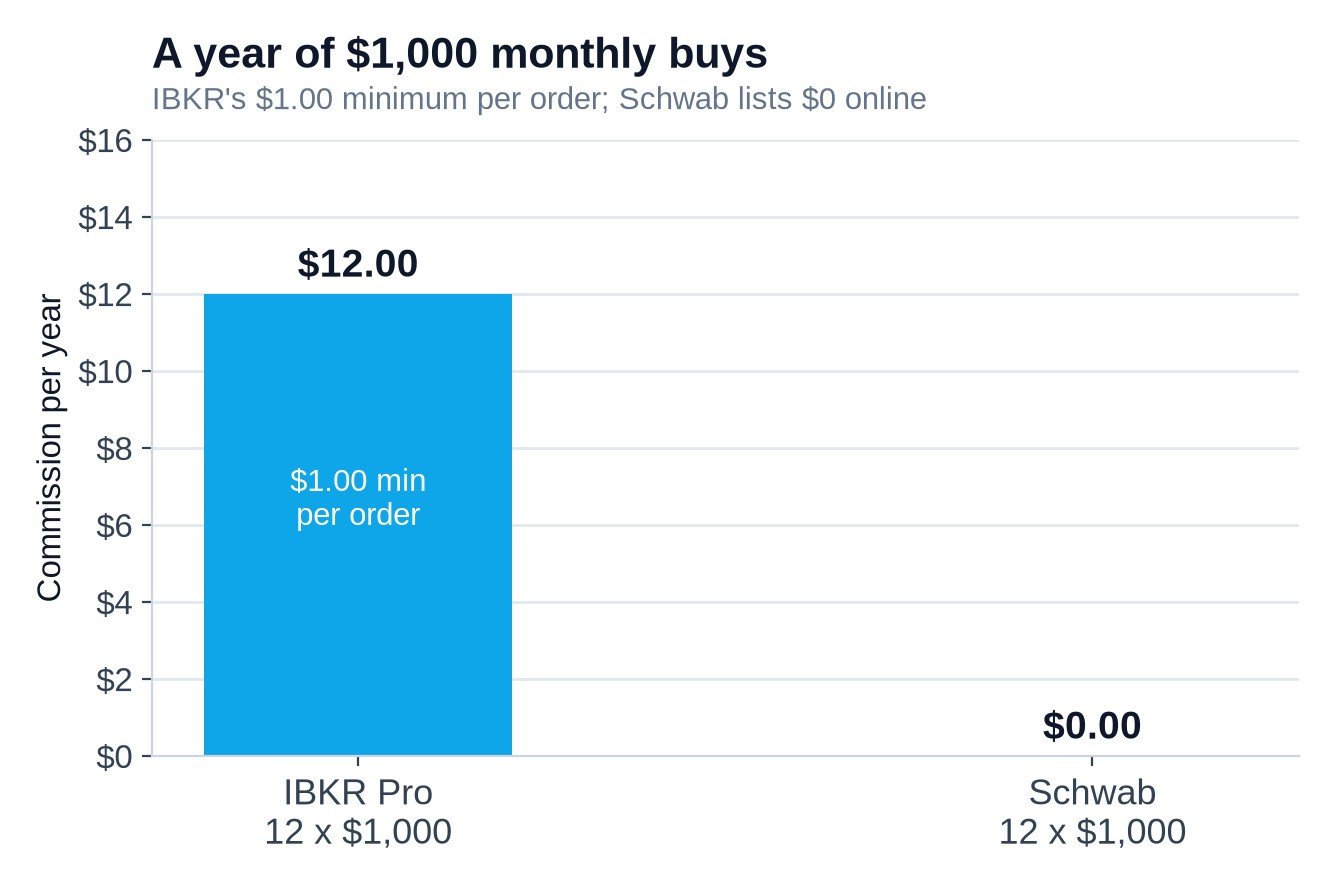
Schwab’s $0 online commission is not just cheaper than IBKR’s per-share rate on large orders — it is dramatically cheaper on small ones, because IBKR applies a $1.00 minimum per order.
Twelve monthly buys of $1,000 cost $12.00 a year at IBKR and $0 at Schwab. If your plan is a steady monthly purchase rather than one large position, that flips the commission comparison.
Moving money out
IBKR allows two free withdrawal requests per calendar month. After that a USD bank wire costs $10 and an ACH transfer $1. Schwab charges $25 for an outgoing wire, or $15 if you submit it online, and nothing for incoming wires.
For a long-term investor who moves money once or twice a year, both are rounding errors next to the conversion difference. For someone repatriating profits monthly, IBKR’s free allowance is worth more.
W-8BEN: same form, different consequences
Both brokers require a W-8BEN so they can treat you as a non-US person and apply your treaty rate instead of the default US withholding. Both treat the form as valid for roughly three years and ask for a new one when it expires.
The penalties for letting it lapse differ. IBKR says that without a valid W-8 it will assume non-US status but withhold at 30% on interest, dividends and gross proceeds. Schwab states that with no valid form on file it must withhold 24% of gross proceeds from sales and certain redemptions and up to 37% of dividends, interest and other US-source payments.
Set a reminder for year three. Both brokers email before expiry, but a lapsed W-8BEN is one of the few admin mistakes that costs real money on every dividend until it is fixed.
Which broker fits which investor
IBKR suits investors who convert currency, trade more than one market, or want access to non-US exchanges. The per-share commission and $1 minimum are trivial on large orders, and the currency saving can be thousands of dollars a year.
Schwab suits investors who already hold dollars, buy US ETFs once a month, and want a simple phone-and-website experience with $0 commissions. The 3% conversion markup is the cost to watch.
Neither is “better” in the abstract. Pick by the currency you earn in and the size of your orders, not by the commission headline.
Frequently asked questions
Does Schwab still require $25,000 for international accounts?
Schwab’s current pricing guide lists the Schwab One International minimum deposit as $0. The $25,000 figure comes from older versions of that requirement and is still repeated by third-party guides.
Can I buy US ETFs from either broker as a non-resident?
Yes, subject to your country. Schwab restricts applications to qualifying countries and notes that not all products are available everywhere; IBKR accepts most countries outside US sanctions lists.
Which is cheaper for a $100,000 portfolio?
It depends on how the money arrives. With dollars already in the account, Schwab is cheaper to trade ($0 versus $14.55) and slightly cheaper to withdraw from online. Converting $100,000 at the broker reverses that by up to about $3,000.
Do I need a US address or Social Security number?
No. Both accounts are built for non-US residents and are opened with a passport, proof of foreign address and a W-8BEN.
Sources and how we checked
All figures were read on the firms’ own pages on Nov 24, 2026.
- IBKR Required Minimums — $0 account minimum and $0 inactivity fee for individual accounts.
- IBKR Commissions & Fees — per-share tiers, $1.00 fixed minimum, IBKR Lite eligibility.
- IBKR Spot Currencies — 0.20 bp, $2.00 minimum, 0.03% auto-conversion.
- IBKR Other Fees — withdrawal allowances and wire fees.
- IBKR tax information for non-US clients — W-8BEN rules and withholding.
- Charles Schwab Pricing Guide for Individual Investors (April 2026) — minimum deposits, commissions, wire fees, conversion markup.
- Schwab International fees & commissions — online $0, broker-assisted $25, non-US ETF fee.
- Schwab International FAQs — W-8BEN validity and withholding consequences.
Disclosure. ETF Sheet is an independent information site and is not affiliated with Interactive Brokers or Charles Schwab. This article is for education, not advice, and it is not a recommendation to open an account. Fees change; confirm them on the provider’s page before acting.
Free · weekly
Get the ETF sheet
One email a week: ETF and dividend comparisons with the numbers laid out — expense ratios, yields, holdings overlap, and the sheets we publish.
Free, no spam. Unsubscribe in one click.